Friday, February 22, 2013

Long time, no links. HOT LINKS lives.


Grand Central Station. December 2012. Photo by The Preservator
Holy Moses, has it been this long? Preservator readers - all three of you - I apologize. I have been cheating on you, writing for a certain Philly-centric online outlet. But, let's be real, I miss being here too. So let's not dwell in neglect, but push on where we left off.

Here are a few Friday HOT LINKS:

JFK's PanAm Worldport (now Delta Terminal 3) building is a goner [Atlantic Cities] To be fair, this once futuristic, jet-age wonder has seen better days, but what a bummer. savetheworldport.org
What's a tree worth? Maybe more than your house. [Next City]
Affordable LGBT housing for seniors in Philly's Gayborhood by Wallace Roberts Todd [A/N blog]
Why the Philadelphia Historical Commission won't process any nominations [Hidden City Daily]
Isn't it time to divorce Penn Station and Madison Square Garden? Kimmelman says yes. [NYTimes]
LPC designates 5 historic firehouses: Sunset Park, Windsor Terrace, Longwood, Rockaway Park, and Bathgate [A/N blog]
Grand Central Station at 100, a look at this beauty past and present [A/N blog]
 

Thursday, June 23, 2011

Robert N. C. Nix, Sr. Federal Building and U.S. Courthouse


Created with Admarket's flickrSLiDR.


Philadelphia is not especially well known for its collection of Art Deco/Moderne architecture, but it is home to some real treasures of 1930s design. One of my favorites is the monumental Robert N. C. Nix, Sr. Federal Building and Court House, taking up half of the block along the western side of 9th Street between Chestnut and Market. The Nix building was constructed between 1937-1939 as a project of the Public Works Administration, a federal initiative to provide jobs and economic activity surrounding public construction projects as part of the nation’s recovery from the Great Depression.

The Nix building is a stylized Moderne structure built out of Indiana Limestone, with simplified classical design elements. The entrances to the Court House, on Market and Chestnut, are flanked by huge bas-relief granite sculptures depicting allegories of justice and the rule of law. My favorites, however, are the bas-relief sculptures along 9th Street showing postal carriers in different parts of the United States. 

For especially good interior photos of the post office and courts, visit the General Services Administration page for the Robert N. C. Nix, Sr. Federal Building and U.S. Courthouse.

All photos above by Preservator.

Monday, June 13, 2011

Monday Roundup: Kimmel Center redesigns, Kensington's Visitation BVM Matters, PHA Property Disposal, SEPTA Goes Hybrid

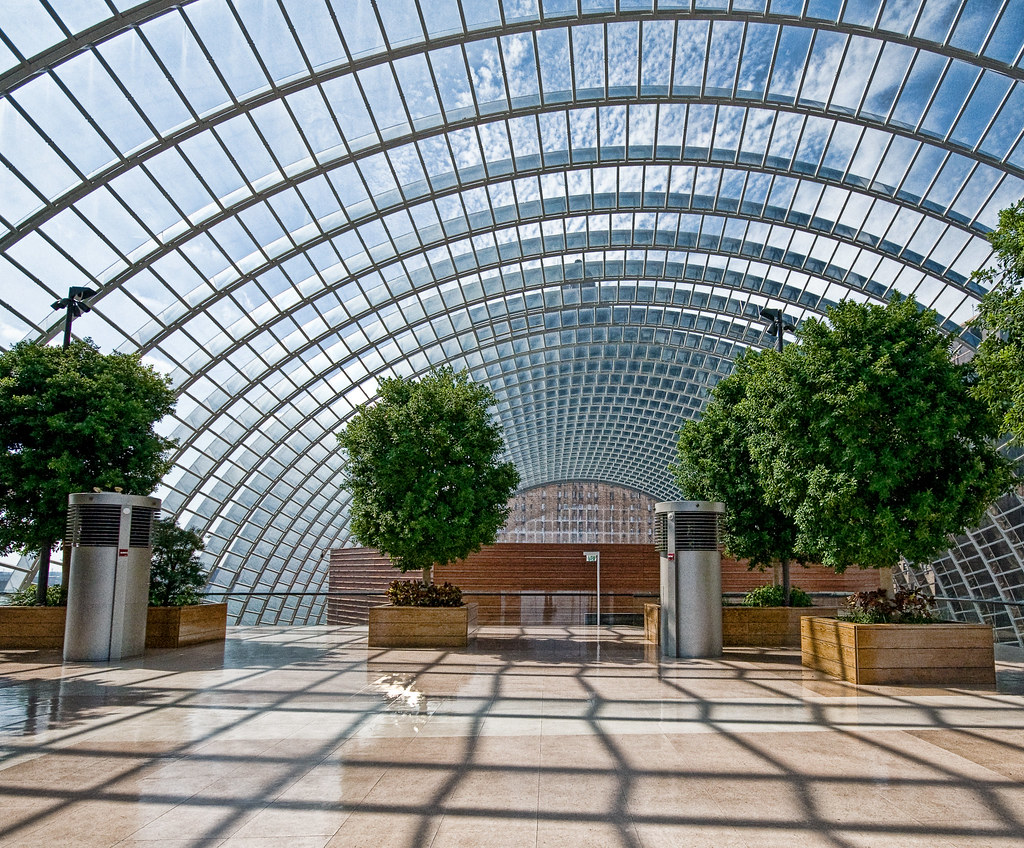
Dorrance H. Hamilton Garden at the Kimmel Center, 2009.           photo by Bob Jagendorf / flickr / creativecommons license.
Renderings for the BLT Architects redesign of the Kimmel Center's Dorrance H. Hamilton Garden have been released, revealing a more functional event space - check them out on the A/N blog.

West Kensington's beautiful, twin-spired Visitation BVM Catholic Church (built in 1879) is a finalist in the National Trust for Historic Preservation's "This Place Matters" grant competition. The $25,000 prize would support Visitation's church, school, and community center. Vote for Visitaiton BVM here.

The Philadelphia Housing Authority is seeking nonprofit takers for more than 1,000 of its vacant properties, and will over more than 1,200 to the public at market rates. [Inquirer] 

SEPTA plans to install batteries along the Market-Frankford line to capture and store power generated as trains stop [New York Times Green blog].

Friday, June 10, 2011

Photo Friday: Hot Hot Heat + Hot Links

Seger Playground, Philadelphia. Photo by The Preservator.
Whoa nelly. Hot times. Don't forget that the City of Philadelphia has an interactive map designed to help you beat summer heat, showing swimming pools and cooling centers. Click here.

I really miss phillyskyline.com. Brad Maule, the man behind the lens and the words, returned to Philly briefly and posted a great photo essay of his trip on his new website, Maule of America, here. It makes me miss PhillySkyline even more.

Over at PhillyHistory, Shawn Evans posted about the prevalence of the city's neighborhood movie theaters. The pictures of these lost picture palaces are fantastic.

According to the Philadelphia City Planning Commission, The Future Begins Now. This week the commission adopted the Philadelphia 2035 Citywide Vision this week. If you're up for the long read, download the full thing here, or the summary here. Inga sums it up in this week's Changing Skyline.

Travel Postcards: Pittsburgh, Santa Barbara, and Catskills

In the last month, I went to Pittsburgh twice, zipped west to California, and drove up to the Catskill mountains. More on Philly soon. Meantime, here are some postcards from my travels.

Clayton, Frick Art & Historical Center, Pittsburgh, PA. Photo by The Preservator
In Pittsburgh I visited Clayton, the centerpiece of the Frick Art & Historical Center - a Victorian jewel built for Henry Clay Frick.  History does not recall Frick kindly as an industrialist. (Recall the blood shed on his orders during the Homestead Steel strike in 1892.)  But, Frick is well-regarded for his vast art collection and as a museum benefactor. At home, Frick was a man of style. Clayton, is a delightful Victorian pile in the Point Breeze neighborhood of Pittsburgh. The house is a museum with original furnishings and objects intact and offers a portrait of how swells like the Fricks lived in Pittsburgh. Beautiful gardens, a really good cafe, and a free museum round out the five-acre complex.

Santa Barbara, California. Photo by The Preservator
 Oh, California. Land of my youth! It was a quick visit for a family occasion, but I still managed to put my feet in the Pacific Ocean and watch dolphins playing near the shore. I stand by my conviction that the Pacific is superior to the Atlantic. Sorry.

Photo by The Preservator
Palms to pines. This is the lake in the Catskills where my grandmother lives. It's the most beautiful place I know.

Friday, June 3, 2011

Hot Links - Weekend Edition

Repairing / Remodeling - Bainbridge and South Reese St, Philadelphia. Photo by The Preservator

Hot Links:
Philadelphia Inquirer building is up for sale (again). [Philly.com]
Bart Blatstein's trashy manners [DailyNews]
SEPTA launches TransitView, for real-time bus and trolley info [TechnicallyPhilly.com]
Changing Skyline History vs. Highrises: An Urban Debate [Inquirer]


This weekend:
Philly Beer Week kicks off today - some picks via PhillyHomegrown [HomegrownBlog]
The Roots Picnic 6/4 at Festival Pier[okayplayer]
Philadelphia Burger Brawl benefit for William M. Meredith Elementary School [facebook]
New farmers market opens this 6/5 in Pennsport's Dickenson Square Park [uwishunu]

Friday, May 27, 2011

Photo Friday: Race Street Pier


I popped over to the newly opened Race Street Pier yesterday. Despite the heat, there were several people there enjoying the new park: a couple of people camped out on the new wood benches in the shade of relatively mature swamp oak trees, a few parked on the steps, and two guys were fishing off the end of the pier.

Field Operations' design succeeds in creating a wide variety of spaces, heights, and textures that are a pleasure to discover along the length of the pier. The trees are already relatively mature, and with time will make the park a cool, leafy landscape along the water. Access to the new park space is easy, though it feels a little lonely in its current setting. Here's hoping it will be connected to more public improvements along the Delaware River in short order.

Maybe it was yesterday's heat, but I couldn't help but think that an ice cream stand would be an fantastic addition at the park's entry.

Enjoy the long weekend, everyone.

Friday, April 22, 2011

Photo Friday: Brooklyn City Hall + Goodbye to All That/Farewell to the Enchanted City*

Palen Postcard, Brooklyn City Hall.

Dear Brooklyn,

Thank you for being The Preservator's home base for the last couple of years. I know you won't take it personally when I tell you that we're leaving you for the friendly embrace of the great City of Philadelphia. You are a beautiful place to live and we will treasure memories of your gorgeous brownstones, awesome parks, and wild residents. We leave you in good hands. You won't even notice we're gone. Meantime, we are excited to get to know what's become of William Penn's Greene Country Towne.

Stay tuned for dispatches from a bit further south, maybe even a new format. Who knows what the move will inspire. We are all works in progress.

Yours,
The Preservator

*Goodbye To All That, by Joan Didion - not exactly my feelings, but worth the (re)visit
(also note - this is what the internet looked like in 1997!)

Friday, March 18, 2011

Photo Friday: Custom House Sunset

Cass Gilbert's U.S. Custom House, Bowling Green, NYC. Built c. 1900. Photo by The Preservator

Wednesday, March 16, 2011

Hot Links

Liquor Store Sign, DeKalb Avenue, Fort Greene Brooklyn. March 3, 2011. Photo by The Preservator.

Queens Graffiti Mecca Faces Redevelopment - via WNYC Culture
If you've ridden the 7 train, you know this building in Long Island City. I can't see how planning more lux-y development in Long Island City is a good idea right now. Not well-timed.

The Old American Dream Is A Nightmare - via Grist
Jim Kunstler, an old favorite, chats with Grist, breaking down why the skyscraper won't save us, how the New Urbanists have won, with requisite smatterings about the national debt and - of course - peak oil. And - beware the photo - our man looked better sans mustache. (Also, I saw someone reading his peak-oil futurist novel, World Made By Hand, on the subway this morning.)

Hoping Gowanus Canal Cleanup Turns Up Old Treasures - via NYT
What is not to love about urban archaeology of the forgotten Gowanus landscape?! Superfund = superfun!

Friday, March 11, 2011

Loss: I.P. Morris Machine Shop #2


I.P. Morris Machine Shop #2, Philadelphia, 2006-2007. by The Preservator.

Meet an old friend of mine, the I.P. Morris Machine Shop #2.  Since the early 20th century, this building sat along Richmond Street, facing the Delaware River in the Fishtown neigborhood of Philadelphia. Its early history was spent as a manufacturing facility, creating iron machine parts for the internationally renowned William Cramp & Sons Ship and Engine Building Company.

Fishtown was a major manufacturing area well into the 20th century.  There, along the Delaware River, Cramp grew into an industrial powerhouse over the course of a century. During the Second World War, Cramp's operations peaked, ultimately employing about 15,000 people (largely Fishtown/Kensington residents) on its 65-acre campus. Cramp shut its doors in 1946.

The long decline of industrial Philadelphia has meant that many large manufacturing facilities remain untouched, while others are demolished. The I.P. Morris Machine Shop #2 was the last vestige of Cramp's once enormous presence in Fishtown. This year, after years of planning, the Machine Shop is being demolished to make way for a new ramp for I-95 intended to handle traffic for the new Sugarhouse Casino a few blocks south.

In 1994 the Pennsylvania Historical & Museum Commission had deemed the building eligible for listing in the State/National Registers of Historic Places. I always liked its raised monitor windows and the railroad tracks leading into the bays suggesting its industrial past. This is all that remained as of Wednesday:
via www.95revive.com
Want more? Peep this:
95 Revive: Cramp Building Coming Down
PlanPhilly: Cramp Shipyard Demo Proceeds
PlanPhilly: How One Shipbuilder Impacted Philadelphia and the World

Monday, February 21, 2011

Friday, February 11, 2011

Photo Friday: Parkside Graffiti + Budget Chatter

Parkside Avenue Station, B/Q subway surface line. Photo by The Preservator, 2010.

February is short for a reason. It brings dreary days here in the Northeast, but also it opens budget season. On the latter, those of us who care about the built environment should brace for change.

Federal Preservation Funding is On the Chopping Block (Again)
Hard times bring drastic measures. Even though persuasive arguments can be made about the economic impact of preservation projects, federal and state preservation programs and grant pools are likely to face deep cuts this year. The two big federal grant programs: Save America's Treasures and Preserve America are likely to be slashed if not eliminated, and huge cuts to the Historic Preservation Fund (which provides funding to states for preservation programs and grants) and other cultural resource programs also seem likely.
The National Trust's blog PreservationNation.org breaks down the issues at hand here

President Obama Commits to Funding National Rail Improvements
It was heartening to hear Vice President Biden announce a new six-year federal commitment to upgrading the nation's passenger rail system, starting with a proposed $8 billion for this effort in the President's budget proposal. Biden made the announcement at a whistle-stop at one of America's loveliest historic rail stations, Philadelphia's 30th Street Station. "Amtrak" Joe has long been an advocate for improving our railways. "I understand the need to invest in a modern rail system that will help connect communities, reduce congestion and create quality, skilled manufacturing jobs that cannot be outsourced," he said.

Here, here! This is smart money that will help put rail on a more equal footing with investments in road and air travel. Our nation deserves this sort of forward-thinking investment spending that creates mass transit that is not so dependent on oil. That said, Congress is in a slash and burn mode with Federal spending, so we'll see how far this really gets.
NY Times article here.
DC Streetsblog post here.

Tuesday, February 8, 2011

Must Reads of the Week: Active Preservation + the Splendor of Cities

Must read of the week goes to Mario Ballesteros' article in Domus, A Call To Account! A Case for Active Preservation, really got the wheels turning this week. He writes:
In contexts of crisis, architectural preservation—of buildings, but also of structures, archives, discarded or abandoned plans, as well as other minutiae and ephemeral documentation—becomes an indispensable tool for critical, political, and historical disclosure. Historical value, in this sense, transcends formal architectural merit. Preservation needs to move away from nostalgia and surface; it needs to be cold, clinical, and combative.
Ballesteros' piece is a ballsy reminder of what preservation is good for: survival, deeper cultural understandings, and inclusion. In particular, the Preservator loves the idea of preservation as disclosure.

And while we're out recommending articles, I hope you didn't miss today's NY Times column by David Brooks, Splendor of Cities. Brooks echoes the pro-urban ideas of thinkers like Richard Florida, and reminds us: "Cities thrive because they host quality conversations, not because they have new buildings and convention centers." Word.

Friday, January 28, 2011

Photo Friday: Snowy Harbor Seagull + Hot Links

Photo by The Preservator
Hot Links:

In Athens, GA stands the steeple of St. Mary's Episcopal Church. It just so happens that said church was, at one time, a DIY venue where R.E.M. played it's first gig. Today the steeple is all that remains of the church/venue and its current property owners (a condo association) have voted to demolish rather than restore the steeple.  Signs that the times they-are-a-changing? The National Trust's Preservation Magazine covers the story online here. Hmm.

For years communities and advocates have been working to improve the health of the Bronx River. Now, there's more multi-municipal cooperation. Bravo! Jose the Beaver thanks you too! (via NY Daily News)

Over at Rorotoko Elizabeth Collins Cromley breaks down her new book, The Food Axis: Cooking, Eating and the Architecture of American Houses, which contends that the ways in which food is stored/prepared/preserved/consumed has driven domestic architecture and its adaptations over time.

Oh yeah, and Wal-Mart has opted to find a different development sight after years of seeking to build a Supercenter in Orange County, VA on the site of the Wilderness Battlefield, one of the Civil War's most important. The National Trust explains. Reenactors and buffs like yours truly, rejoice.

Thursday, January 27, 2011

Iron and Snow

Photo by The Preservator
 Trinity Church's Fence, Wall Street and Broadway, NYC. January 27, 2011.

Friday, January 21, 2011

Photo Friday: Flatiron + Hot Links

Flatiron Building, December 29, 2010 3:49pm
Photo by the Preservator

Hot Links + Strays:
Polis recently posted a piece about how relevant Jane Jacobs' thinking about the use of old buildings, 50 years later. Even lovers of Jacobs' writing, including yours truly, can get tired of the endless rehashing of her influential writing. Still, this piece reminds us that old buildings, in big expensive cities like New York, provide space for entrepreneurship. Do read.

Philebrity shared this rad portal into the future/past... er the future of the past. Something. Hi-Tech Psychedelic Past/Present Philly Street View promised. If you've ever wondered about how the Preservator wishes to experience the world. This is so close.

ArchPaper reports about a new level of destructoporn: Buffalo artist who's creating art out of pieces of abandoned buildings in an installation called Undone/Redone City.

Harlem Bespoke unearths details about this beautiful horse fountain at 155th and St. NicholasPlace in Hamilton Heights/Sugar Hill. NYC Parks has more info about the Hooper Fountain's restoration. Among the many streetscape treasures that delight the Preservator are horse fountains, most of which were built at a time when the ASPCA and its local chapters were on the rise. They make us think of kindness.

Amusing the Zillion tipped about an exhibit at Schroeder Romero & Shredder, Nickel Empire: Coney Island Photographs 1889-1948. It's up from January 27th-February 26 and looks great.

While we're on the subject, don't think we didn't notice, but in the last month the Coney Island debacle has continued with the demolition of the Bank of Coney Island and the landmarking of both Childs Restaurant and the Coney Island (Shore) Theater on Surf Avenue.