Showing posts with label Brooklyn. Show all posts

Friday, April 22, 2011

Photo Friday: Brooklyn City Hall + Goodbye to All That/Farewell to the Enchanted City*

Palen Postcard, Brooklyn City Hall.

Dear Brooklyn,

Thank you for being The Preservator's home base for the last couple of years. I know you won't take it personally when I tell you that we're leaving you for the friendly embrace of the great City of Philadelphia. You are a beautiful place to live and we will treasure memories of your gorgeous brownstones, awesome parks, and wild residents. We leave you in good hands. You won't even notice we're gone. Meantime, we are excited to get to know what's become of William Penn's Greene Country Towne.

Stay tuned for dispatches from a bit further south, maybe even a new format. Who knows what the move will inspire. We are all works in progress.

Yours,
The Preservator

*Goodbye To All That, by Joan Didion - not exactly my feelings, but worth the (re)visit
(also note - this is what the internet looked like in 1997!)

Wednesday, January 12, 2011

The Snowy Day

Okay, well, maybe it's not a Snow Day for us in New York City today. The Preservator didn't grow up in snowy climes so snow is not a hassle, it's magical. As a kid, these feelings of snow's fantastical wonder were fostered by favorite books like "Katy and the Big Snow," by Virgina Lee Burton and especially, "The Snowy Day" by Ezra Jack Keats.

"The Snowy Day" finds a little boy named Peter waking up to winter's first snowfall and he sets out to explore his urban neighborhood. He has adventures listening to the crunch of snow underfoot, making snow angels, looking at the snowball fight the big kids are having.

Ezra Jack Keats was the son of Polish immigrants who grew up in East New York, Brooklyn. He was an artist and illustrator who began creating his own picture books in 1960. Just like the Brooklyn neighborhoods where his books are set, Keats' books are full of Hispanic, Asian, African American and Anglo faces. In "The Snowy Day" you can see Brooklyn everywhere; its streetscapes, the rowhouses, shops, and oh the ironwork! I still love the strong lines, bold colors, and texture of the illustrations, created using paint, gouache, collages of paper and fabric.
Image from the Keats archive at the Library of the University of 
Southern Mississippi's de Grummond Children's Literature Collection
If you are out and about today, at the library or bookstore, thumb through "The Snowy Day". Remember what it's like to find wonder in your neighborhood transformed under a blanket of snow. Engage your senses. Be an urban arctic explorer.

Thursday, December 23, 2010

Merry Christmas to all, and to all Dyker Lights

Even for the Grinchiest among us, the awesome spectacle of the Dyker Heights Christmas lights and displays in Brooklyn are a surefire holiday pick-me-up. So, as a Christmas gift to you, we offer an early PhotoFriday installment of the Dyker Lights.

No one really knows where the tradition began, but for decades this Brooklyn neighborhood of victorians, twin rowhouses, and 20th Century mini-palazzos is transformed into a winter wonderland of blinking lights and audio-animatronics. In lots of neighborhoods, people are content to hang a wreath or drape the railings with swags of evergreens. The blocks between 10th and 13th avenues and 81st and 85th streets in Dyker Heights take holiday decor to the next level. We're talking about 30' Santas, robotic polar bears, and light shows.

So, to you, dear reader, Happy Holidays from the Preservator. We'll see you in the new year.

84th Street is the heart of the action!

The Preservator has a weakness for light-up toy soldiers.

This house has the most elaborate, enormous, over-the-top displays of all. Too much is never enough.

Hop on the Polar Express!

Even the local fire company gets into the spirit.
All photos by @shrimpcracker

Wednesday, July 7, 2010

Keep Coney Island Real

The Parachute Jump and the boardwalk.

After a recent field trip to Coney Island, I got thinking more seriously about its future. A major rezoning last year has paved the way for transformative development in this otherwise forgotten corner of Brooklyn.  And with all of this new attention, there's a lot of talk about how to keep the spirit and texture of Coney Island alive.

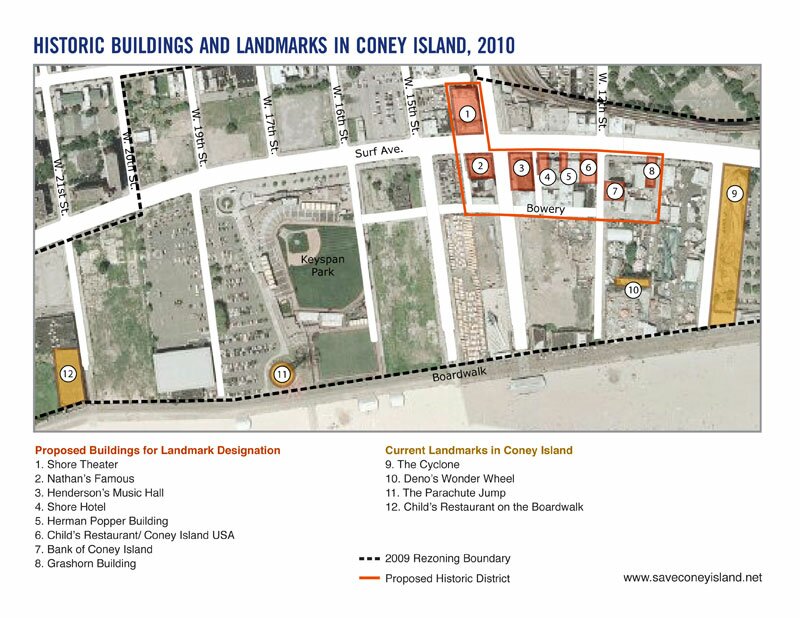
Groups like Coney Island USA and Save Coney Island are advocating for the creation of a small Coney Island Historic District.

Proposed Historic District and Current Landmarks map via Save Coney Island.

The only existing NYC landmarks in Coney Island are: The Parachute Jump, The Cyclone, The Wonder Wheel, and Childs Restaurant on the Boardwalk. And, I must say, I love each of them. Childs is a wonderful, romantic, decaying relic of terracotta in oceanic themes. The Cyclone is still a thrill for kids of all ages, including me.  And, like the Cyclone, the Parachute Jump and the Wonder Wheel are important living memories of summers past for many New Yorkers.

 Childs Restaurant on the Boardwalk, above, and thrills on the Cyclone, below.

Attempts to landmark a few, heavily altered buildings appear to be dead in the water.  These buildings are significant not for architectural integrity but their cultural history.  I have no issues with designating cultural landmarks, and doing so for Shore Theater and Nathan’s Famous (see below) would be a nice olive branch given the scale of development that the city envisions.

The Shore Theater, above, and Nathan's Famous, below.

Landmarking these buildings won't “save” Coney Island. Nor will a small district. In this case, an historic district can only hint at what was once common: a richly varied place full of visual chaos, wild amusements, fanciful entertainment, and cheap thrills.  I say, instead, focus on making Coney Island a rich, diverse, wildly entertaining place for New Yorkers of every stripe.

Surf Avenue Coney Island, c. 1910 Library of Congress , Flickr Commons Project

In 2009 the rezoning of Coney Island advanced a new city vision of developer-driven change for Coney Island: one in which hotel and residential towers commingle with neighborhood scale retail, and the amusement areas would be condensed to the area between the ballpark and aquarium. I can understand the concentration of games and rides into one location, and I see the value in making it a more year-round destination. Encouragement new development for Coney Island is also a great goal, though I fear the possibility of homogenization, mediocrity, and privatization of the amusements and amenities. Coney Island is a place for everyone and it should stay that way. (Even if the Cyclone costs $8 for your first ride, the beach is but a subway fare away.)
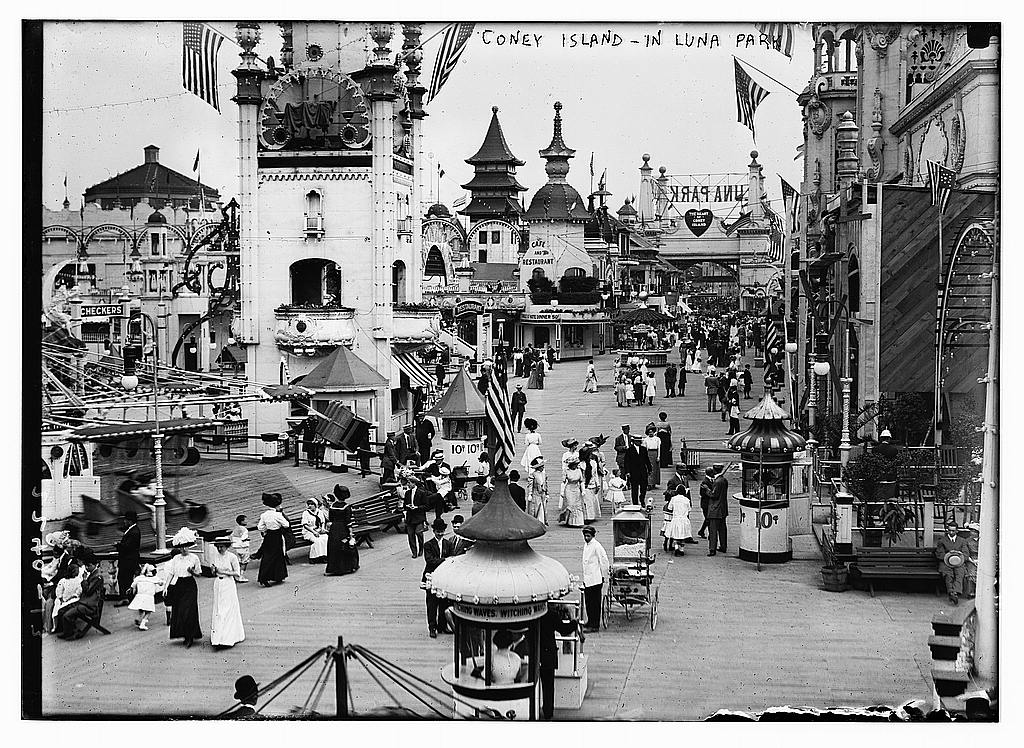
Inside Luna Park, Coney Island, Library of Congress Print and Photograph collection.

Inventive eye-catching attractions and fringe amusements have always characterized Coney Island as New York’s great playground, making it a seaside destination of choice.  Opportunistic developers who used their imaginations made that happen. I would hope that any new development – especially those benefitting from the city’s rezoning or through financial incentives – would keep that in mind.

One feature of Coney Island I feel very strongly about keeping firmly in its place is the boardwalk.  This should be designated as a Scenic Landmark, the same way Eastern and Ocean parkways are.  What would Coney Island (or Brighton Beach) be without its boardwalk? The city should be obligated to maintain it in perpetuity to ensure uninterrupted public access.  Coney Island has had a boardwalk since the 1920s, and it should stay that way.

Coney Island may be a shadow of its former self, but it has good bones.  There’s incredible potential for a renewed Coney Island to demonstrate the values that make New York great: world-class public amenities, imaginative development, and something for everyone.  I don’t see the zoning process or landmarking bringing that about on its own. The large land-holders, like New York City and Thor Equities, need to consider very carefully and think creatively about how to invigorate Coney Island as a richly textured destination. This could be achieved with fine-grained smaller site development, and making space for a large variety of small vendors, kiosks, and games, particularly close to the boardwalk.  It should feel like a bizarre bazaar, not a monolithic or sterile place.

 The Bowery, Coney Island c. 1912, Library of Congress, Print and Photograph Collection.

Coney Island could thrive anew with a density of creative and interesting, amusements and amenities that would attract New Yorkers of every stripe.  There are plenty of vacant lots to build on: start there. Restore Childs on the Boardwalk to anchor an otherwise desolate stretch of boardwalk. Encourage vendors to extend the small shops along the boardwalk to keep it lively and affordable.

Developers, property owners, and the city alike should strive to make Coney Island an adventure, but keep it real.

For More Information check out:
The NYC Department of City Planning's Coney Island rezoning info here.
Coney Island USA's website.
Library of Congress's Sanborn Time Series on Coney Island here.
Library of Congress's Flickr Commons Project Coney Island collection here.


Color photos by Preservator, all rights reserved.

Monday, June 28, 2010

Brooklyn Beach Amusements of the Past

Next up in the Preservator's occasional Palen Postcard series comes a few from the Brooklyn beach amusements of yesteryear. You'll notice that the rides and the atmosphere seem really elaborate, especially by comparison to today's Luna Park, which looks a bit fly-by-night.  

This set is inspired by my trip to Coney Island this past Sunday. I rode the Cyclone and nearly lost my glasses. Twice. It was great. We checked out the local landmarks, and walked the boardwalk. More on Coney Island later, for now the postcards please.


Created with Admarket's flickrSLiDR.

For more Palen Postcard check these: Prospect Park in Postcards

Wednesday, April 28, 2010

not at HOME with Atlantic Yards

In the demolition footprint of the Barclay's Center, future home to the Nets, and next to Freddy's bar, at 38 6th Avenue is this small former industrial building.  As their own sweet protest the building's residents painted this mural in mid-April.  According to this piece from AtlanticYardsReport the couple are among the last residential holdouts.


photo by Preservator, 4/28/10

Here's the video of them painting the mural.


Untitled from katherinekrause on Vimeo.

Monday, April 26, 2010

Prospect Park in Postcards


Created with Admarket's flickrSLiDR.

The Palen sisters were my great grandmother's neighbors in Nyack, NY.  By sheer luck I ended up with their collection of fantastic historic postcards.  Here is a selection of historic postcards of Prospect Park in Brooklyn, New York, sent between 1904-1919 to and from the Palens. 

Fredrick Law Olmsted & Calvert Vaux designed Prospect Park after Central Park.  Since it was built in 1860 the park's widely varied landscape has changed much, but still includes Olmsted & Vaux's meadows, woodlands, and ponds. The park's majestic entrances were designed by McKim, Meade and White.

This marks the first of an occasional series of Palen Postcard posts.

Tuesday, August 4, 2009

Stolen Summer: movies with a view

Back to Brooklyn Bridge Park for a moment: I'd forgotten that this year marks the 10th year of the free movie series on Thursday nights. This year's theme is "Stolen Summer," and the August lineup is full of adventure.

August 6: The Return Of The Pink Panther

August 13: Butch Cassidy And The Sundance Kid

August 20: Catch Me If You Can

August 27: Edward Scissorhands

The festivities begin at 6pm with DJs from Brooklyn Radio, food sold onsite is from RICE. No booze or pets, but ride your bike and park it using Transportation Alternatives' (a sponsor) free bike valet service.

Wednesday, July 22, 2009

Brooklyn Bridge Park: anticipating the new softer edge

On a walkabout on the Promenade this morning, I got to thinking about hard and soft edges for urban waterfronts, the BQE rumbling below, the concrete piers extending into the East River, the overgrown and decayed pylons. The piers seem so crisp, even in disrepair, and foreign against the river. Yet on Pier 3 sits a stand of many varieties of trees, and with them the promise of a new future for Brooklyn Bridge Park.

I'm looking forward to seeing how Brooklyn Bridge Park will ultimately reinvent and soften the waterfront edge. Ecologically speaking, the recreation of salt marshes and wetlands will create healthier and more dynamic tidal ecosystems along the shoreline, while the reinsertion of permeable surface will create recharge zones that will help reduce pollution from urban stormwater. Environmentally responsible methods are being employed in the park's construciton as well. I'm impressed by the level of care being taken to recycle and reclaim materials from demolition in the park's construction, such as stones from the Willis Avenue Bridge and timbers from the demolished Cold Storage Warehouse.

Back in May the trees for Piers 1 and 6 were set into a temporary space on Pier 3 (above). Pier 1 will be the first to open this winter. Next month there are construction tours on tuesday nights. RSVP requested. Who wants to go with me?

Construction Updates
Brooklyn Bridge Park Conservancy
Brooklyn Bridge Park Development Corporation

Tuesday, June 9, 2009

Burn: Oroussoff on Atlantic Yards

Nicolai Oroussoff's review in the New York Times of the Ellerbe Becket design for the Nets new arena at Atlantic Yards is scorching. It is at once an indictment of the project's current state, but also decries the most odious aspects to large-scale urban development today: greed and a lack of concern for the public realm, Oroussoff writes:

"Its low-budget, no-frills design embodies the crass, bottom-line mentality that puts personal profit above the public good. If it is ever built, it will create a black hole in the heart of a vital neighborhood.

"But what’s most offensive about the design is the message it sends to New Yorkers. Architecture, we are being told, is something decorative and expendable, a luxury we can afford only in good times, or if we happen to be very rich. What’s most important is to build, no matter how thoughtless or dehumanizing the results. It is the kind of logic that kills cities — and that has been poisoning this one for decades."


But he also gives Frank Gehry's design its due, acknowledging its thoughtfulness and creativity, regardless of what early detractors said.

Tuesday, June 2, 2009

Go-Go-Gowanus

I love the idea that Brooklyn's Gowanus Canal is both eligible for listing on the National Register of Historic Places and a proposed Superfund site.

The Gowanus Canal is an industrial waterway, flanked by industry, overpassed by a subway viaduct, and surrouned by yuppified/gentrifying neighborhoods (Park Slope, Carroll Gardens, Red Hook). It is a strongly industrial place marred by pollution, but also a cultural landscape that has remains due to continued use. Originally the area was tidal wetlands and creeks that were host to early millworks. The canal was built to meet the needs of increasing industrial production in the mid-1800s. Marshes were drained (more on those in a future post) and the 1.5 mile Gowanus Canal quickly became an important maritime and commercial hub. But after more than a century of industrial and municipal pollution, the Gowanus Canal is so degraded it may become a Superfund site.

So environmental and preservation groups are as interested in what happens as the state and local government are. But what’s next for the Gowanus Canal remains anybody’s guess:


Today's industrial canal may yet be tomorrow's historic waterfront property.


Wednesday, May 27, 2009

Preserve Admiral's Row

Preserving Admirals Row from MAS on Vimeo.

Check out this video from the Municipal Arts Society about Admiral's Row at the Brooklyn Navy Yard.

There is a meeting tonight that is part of the Section 106 process related to the preservation/development and demolition of Admiral's Row. To support the preservation of these buildings email the National Guard .

UPDATE: The demolition of most of the Admiral's Row buildings has been approved, and only two buildings will be saved.

Friday, May 15, 2009

Fiske Terrace - Midwood Park


Posted by Picasa

Yesterday morning, I came out of the subway at Newkirk Ave to construction and noise. Out onto Foster Ave I walked, and hung a right on East 18th into another world. Fiske Terrace - Midwood Park is one of New York City's newest Historic Districts, and kudos to LPC for designating this beautiful neighborhood. Large turn of the century homes sit shoulder-to-shoulder along lush tree-lined streets, whose greenery is augmented with planted medians. Also, this being spring, it was fully abloom. I think the neighborhood must have gotten a deal on pink azaleas at some point, as nearly everyone has one. This is a real gem.