Thursday, August 19, 2010

Update Bonanza: Coney Island is Historic and Being Demolished / Community Garden Advocates Break Out the Big Guns

Busy times over here at Preservator HQ with updates regarding some topics recently covered on these pages. And you thought summer was a slow news season!


Coney Island:
Last week Coney Island's historic resources received a nod for their importance, as well as demolition permits.

Coney Island's Boardwalk is eligible for listing in the State and National Registers of Historic Places. Photo by Preservator.
On the upside, the staff from the New York State Department of Parks, Recreation, and Historic Preservation trekked out to Coney Island and found that its historic resources - including the boardwalk (!) - are eligible for listing in the State and National Registers of Historic Places. Even though this determination provides no protections that some form of designation would, it's validation of the significance these resources.

Save Coney Island posted the August 12th Determination of Eligibility on their website. In it, the state wrote: "While much of historic Coney Island has been lost through the years due to neglect, fire, or urban renewal beginning in the Moses era, the core of surviving buildings, structures, objects, and landscape features that have remained are valuable cultural assets worthy of recognition and consideration in preservation planning." It also called the amusement district "nationally significant...as the birthplace of the modern American amusement industry."

Almost immediately Thor Equities pulled two demolition permits.
Shore Hotel, Coney Island, Photo by Preservator.
Wrecking has begun at the Shore Hotel and the Bank of Coney Island. Also on the chopping block are the Grashorn Building and Henderson's Music Hall, where Thor is so eager they're even working without a demolition permit.

Henderon's Music Hall, Coney Island, Photo by Preservator.
Careful observers will note that the state's proposed historic district boundaries are much larger than those put forward by advocates. The state, wisely, included the boardwalk. Huzzah!


View Coney Island - DoE boundaries in a larger map

 Note: The blue line is the state boundary for eligible resources, and the pink is the initially the proposed boundary. 

Previously on Preservator: Keep Coney Island Real


Community Gardens:Last week's public hearing about the contentious new rules for New York City's community gardens was apparently well attended and got lots of press. A good list of links is on the New York City Community Garden Coalition's (NYCCGC) website.
City Council Speaker Christine C. Quinn speaking with people waiting to testify at the August 10th public hearing on new rules for community gardens. Photo by Matthew McDermott, Flickr / Creative Commons License.
City Council Speaker Christine Quinn and parks committee chairwoman Melissa Mark-Viverito made the case for the city's community gardens, in a New York Times op-ed yesterday, titled "Constant Gardens for New York." They call for community gardens to become more stable and long-lasting features of New York's urban fabric. They advocate for more permanent and protective rules, a more straightforward process for license renewal and site turnover, and conditions for city eviction. The Council Members are on the mark.

NYCCGC also links to the testimony from former Assistant Attorney General, Christopher Amato, who was the lead lawyer for New York State in 2002 during the case which resulted in the current garden agreement that provides more protections than the current proposed rules. at the August 10th hearing on the new proposed rules. If you're into it, read the 7 page letter. It's a barnburner.

Amato contends that the new rules weaken the protections for community gardens, and violate the spirit of the 2002 agreement. He, more interestingly, makes the case that these gardens are parks by common use (think common law), even if they're not treated the same as other parks run by the NYC Department of Parks and Recreation. Treehugger breaks it down here. While Amato offered his testimony as a private citizen, he happens to be the Assistant Commissioner in the Department of Environmental Conservation Office of Natural Resources.

Previously on Preservator: Machines in the Garden

Tuesday, August 17, 2010

Two Staten Island Majestic Maritime Beauties at Auction

West Bank Lighthouse, Ambrose Channel / Lower NY Bay
Ever dreamed of living along a rugged oceanic coast, left peacefully removed from neighbors but for the gulls, yet still able to come to the big city when you wish? Are you in the market for a retreat complete with round rooms and majestic 360-degree views of New York Harbor? The U.S. General Services Administration has two lighthouses that might just suit your fantasy.

The Staten Island Advance reported yesterday that the U.S. General Services Administration (GSA), the federal government's property ownership/management agency, has put two surplus lighthouses on Staten Island up for auction. Old Orchard Shoal Lighthouse (top) and West Bank Lighthouse (below) are both open for bidding.  The opening bid, which enables a tour on September 1, is $20,000.

Old Orchard Shoal Lighthouse, Gedney Channel / Lower NY Bay


Surplus lighthouses pose a special problem for the federal government - they're expensive to maintain and operate, and many are landmarked.  If a surplus property listed (or eligible for listing) in the National Register of Historic Places, as both lighthouses are, the National Park Service offers these properties to state, county or local governments at no cost through the Historic Surplus Property Program. The objective is to put these buildings into productive public use, and are often leased to local nonprofit groups, while protecting their historic integrity.  If there are no takers, the property can be auctioned by the General Services Administration, which is what's happening with the Old Orchard Shoal and West Bank Lights.

Old Orchard Shoal Light, was built of cast iron and first lit in 1893 to protect ships from hitting the rocky shoals of Lower New York Bay.  Below its octagonal lantern is an observation room, and the keepers's quarters are roughly 1000 square feet.  The West Bank, or Range Front, Light was built on a man-made island and was first lit in 1901, and boasts a 100 foot breakwater.  Both properties are only accessible by boat. (How exclusive!)

Lest you fret about sailors busting up along the rocky shores of Staten Island, know that the lights are automated and will remain operational. And if you're the new owners of one of these lights, the U.S. Coast Guard will still come by to do maintenance (think of them as the super for the light).

Bid info here:
GSA Old Orchard Shoal Light auction website
GSA West Bank Light auction website

Both images are U.S. Coast Guard Photos found here.

Friday, August 6, 2010

Photo Friday: International Telephone and Telegraph Corporation

I walk past this mosaic frequently in Lower Manhattan. The bolt of electricity between the figure's fingers reminds me of this William Blake quote:  "My fingers emit sparks of fire with expectation of my future labors." (Do you think this is how the Internet would like to be depicted?)

International Telephone and Telegraph Corporation, 75 Broad Street, Manhattan
Photo by Preservator; all rights reserved

Machines in the Garden

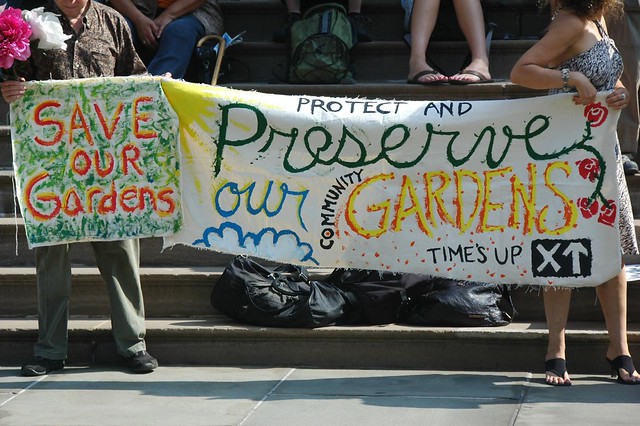
Protest at City Hall 8/4/10 in opposition to new rules for Community Gardens. Photo via Flickr by FlatbushGardener


A greener, healthier city is not one that bulldozes and develops its Community Gardens. But, there is a machine quietly revving in the garden.

New York City’s departments of Parks & Recreation and Housing Preservation & Development have proposed new rules for Community Gardens, which advocates and gardeners say would strip back hard-won protections currently in place. These new rules would allow for the sale and development of any garden citywide not owned by a community land trust or by a city agency.

Before we dive into the disagreement at hand, a little background. 

Recent generations of community gardeners, particularly those in low-wealth neighborhoods, worked hard to create these gardens by reclaiming parcels that were otherwise eyesores and safety hazards: These abandoned lots were overgrown at best and at worst they were illegal dumps, squatters camps, drug dealing spots, etc. Out of the ashes of arson and dereliction grew not only gardens, but community. As neighbors came out to work together, they warded off unwanted activity and created something powerful and productive out of otherwise unwanted spaces. Today’s community gardens still serve these functions and more. Beyond the reclamation and reinvention of these places are really important moves toward creating more resilient and sustainable cities. Community gardens help green cities – filtering air and reducing runoff, beautifying blocks – they help feed urbanites – every little bit counts – and they encourage civic engagement.

In New York, as elsewhere, many community gardens began as informal, ad-hoc spaces with no legal relationship to the land being cultivated. Over time many sites, like those in the East Village, began to face intense development pressure. Still, as some gardens were lost, others became more institutionalized features even as real estate pressures mounted. After the "Garden Wars" of Giuliani's administration, New York's community gardens gained greater security in the form of land transfers to community land trusts or to the city. In 2002, an agreement brokered between the City and then Attorney General Spitzer – brought yet greater protections for some 500 gardens while 150 others were slated for development.  Many gardens worked with the Parks Department's GreenThumb program, which provides support (through largely federal funding sources) for community-managed spaces. 

Because the 2002 agreement sunsets in September, the city has proposed new rules. Advocates like the New York City Community Garden Coalition, say these rules erode protections that were afforded gardens by the old agreement, and in so doing expose gardens citywide to development at the discretion of the city. The draft language of the proposed new rules (Parks rules here) (HPD rules here) treats every garden as a building site. The new rules eliminate the process by which gardens can be transferred into city ownership, meaning that if a garden site is not owned by a land trust or the city already, they effectively are at the mercy of the city’s goodwill.

This is about the gardens being devalued at the expense of potential development. It's about devaluing community-managed spaces and civic participation in something productive and beautifying.  There are provisions that would offer a new lot for the garden to move to, if available, but this misses the point. Gardening takes time. Offering an “as is” lot isn’t an equal trade for a community garden with mature plantings and amended soils. They’re not the same and accepting an alternate site might just mean starting from scratch. Again.

New Yorkers deserve a cleaner, greener, healthier city. Community gardens help fulfill this vital, very 21st Century goal. New York City may have the most intense development environment in the nation, and its policy goals for making the city more sustainable are a model for many other cities. These policy objectives are not in line with the new rules for community gardens. New York City will never be able to produce all of the food necessary to feed itself, but community gardens can help. Better still, they help provide really healthy and affordable food options in low-wealth “food desert” neighborhoods, acting as food banks or donating produce to pantries.

Even as community gardens have waiting lists for plot space, and urban agriculture is a renewed and growing trend, the city fails to recognize the full value of these productive plots, as food sources, community development tools, as green breaks in the concrete jungle. Parks Commissioner Adrian Benape was quoted in yesterday’s AM New York saying, “There is not a universal love of gardens.”  The piece also suggested that he doesn’t believe that the gardens can be made "permanent" because nothing in the city is really forever. Still, he said, “There are no bulldozers being warmed up.” That may only be due to the weakened development climate.

There’s some meaningful research underway that should add good data and policy recommendations for community gardens and urban farms.  Among these are the garden mapping project that Farming Concrete has underway and the Design Trust for Public Space’s Five Borough Farm project. Hopefully these project will also help illuminate the myriad values of the city's gardens.

Community Gardens might not make the city or developers much in the way of money, but wouldn’t New York City be poorer without them?

On Wednesday, August 4th gardeners and supporters rallied at City Hall wielding beets and chard, asking the city leadership to provide greater protections for the city's community gardens.  There is a public hearing on August 10th about the proposed rules. This is your chance to make your voice heard on this issue. Write a letter; call 311; even sign up to testify. Check out NYCCGC’s website for all of the details.

Want to find a garden? Search for a garden via Oasis here.

Friday, July 30, 2010

Photo Friday: Streetview Circa 1889

Oh ninteenth century, how the proud drawings of your creations rule. As does your attention to detail. I submit to you, on this Photo Friday: a visual tour of Broadway in NYC circa 1889. The Mail & Express newspaper published this block-by-block pictorial directory of buildings and businesses along Broadway from Bowling Green to Columbus Circle. It's sort of like a visual yellow pages and map in one. (Come! Cruise Broadway! What a civilzed environment to shop and do business!)


Created with Admarket's flickrSLiDR.

These images can be browsed in the New York Public Library's Digital Gallery, and have been made available through their awesome flickr page. I highly recommend clicking on a few to check the buildings out in higher resolution. Here's one I like showing Trinity Church.

Tuesday, July 27, 2010

All Things Must Pass: Papa's, Lake Luzerne, NY

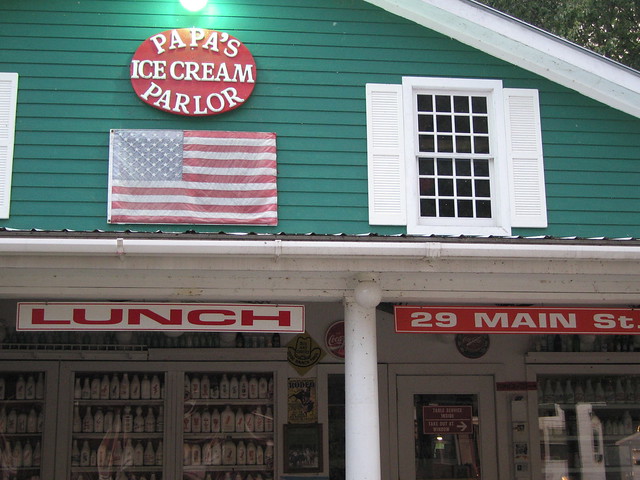
Papa's is the ice cream parlor of my dreams.

Summer visits to Papa's Ice Cream Parlor in Lake Luzerne, NY are among my fondest memories of living upstate.  Lake Luzerne is a village in the Adirondack foothills where the Hudson and Sacandaga rivers meet. Along the Hudson, before the rivers meet, just upriver from a small falls, there is a house with a big porch overlooking the Hudson. That's Papa's.

Papa's was an old school ice cream parlor, even though it was only established in the 1970s. Teenage waitresses working their summer jobs would wear tees saying "Papa's Girl," serving ice cream and soda fountain treats in glass dishes. At Papa's you could sit on the shady dining porch overlooking the river, chow down on a barbecue chicken sandwich, and then contemplate the most important choice of the day: what to eat for dessert. I always chose fruit flavors. My dessert of choice was a brownie sundae with cherry ice cream. Heaven on earth.

Papa's was only open in summer, and each year I dream of visiting. I had my heart set on actually getting to Papa's this summer and I was crestfallen to learn that it is no longer open. Though, I suppose, I'm not totally surprised. In 2002, the original Papa's caught fire and the Gardner family rebuilt their restaurant on an adjacent lot. In 2008 Papa's was sold. Now the building and business are for sale again. Here's hoping someone brings Papa's back to life.

One of the nicest days I ever spent with my friend PD was one Fourth of July more than a decade ago, punctuated by my first trip to Papa's. We walked down to the river and watched boys jumping (terrifyingly) off a bridge into the deep water below the falls. We ate lunch on the porch and gorged ourselves on ice cream. We went back to Saratoga Springs and watched fireworks.
Another piece of fine Americana, gone by the wayside.

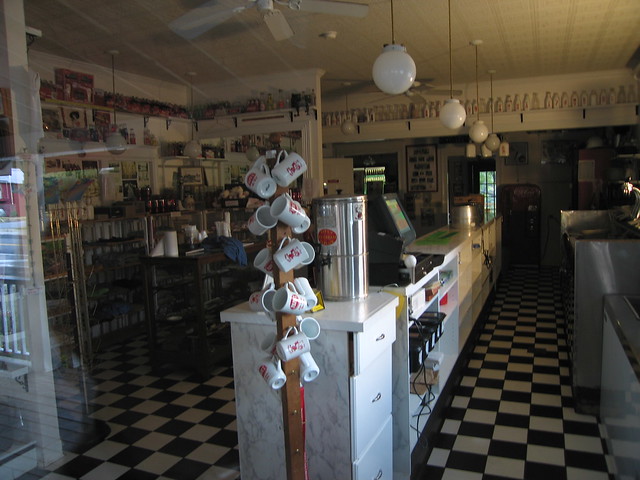
The pencil cup on my desk is a mug from Papa's, a reminder of the sweet things in life.


Photos via Flickr user, warsze

Friday, July 16, 2010

Photo Friday: Berenice Abbott

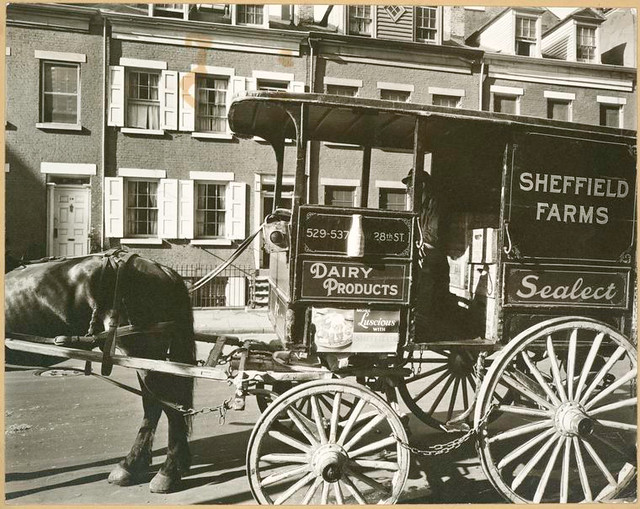
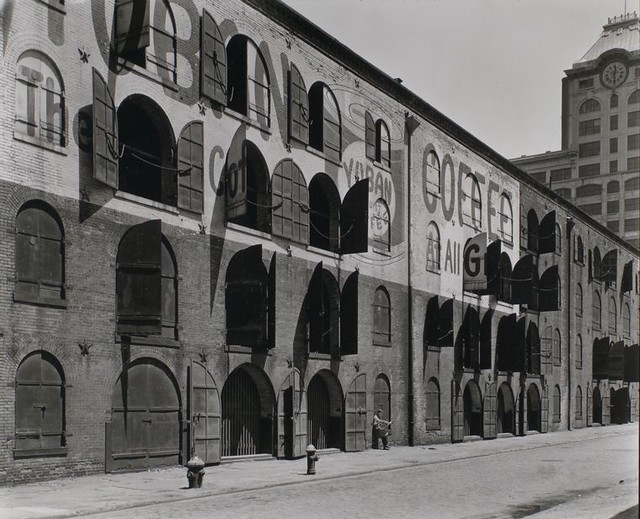
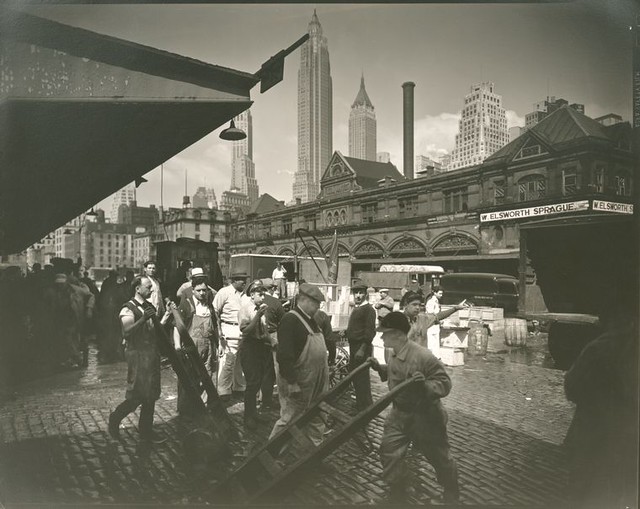
In 1935 photographer Berenice Abbott was hired by the Federal Art Project to work on their "Changing New York" project.  The results, in stunning photographic form, are potent images of everyday life in New York City from 1935-1938. We owe her, and the WPA programs a debt of gratitude for this extraordinary record. Below are a few select favorites, but more can be viewed through the New York Public Library's Digital collection here and through their Flickr account here.

For your viewing pleasure:
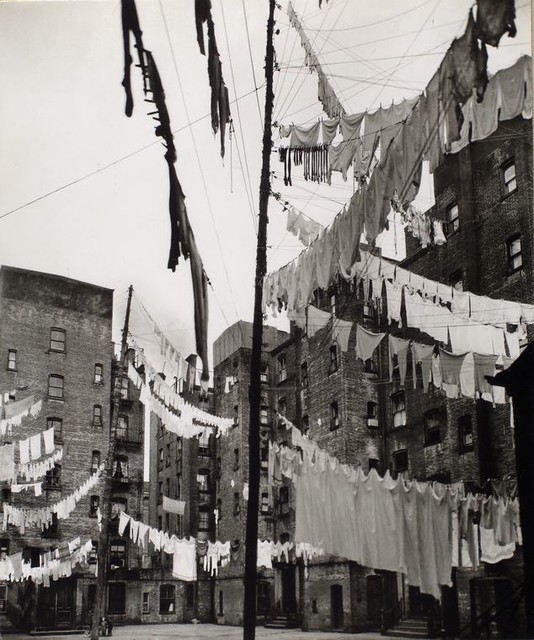
 Court of first model tenement house in New York, 72nd Street and First Avenue, Manhattan.  (March 16, 1936)  
New York Public Library


Milk wagon and old houses, Grove Street, No. 4-10, Manhattan. (June 18, 1936)
New York Public Library
 
Warehouse, Water and Dock Streets, Brooklyn. (May 22, 1936)New York Public Library

Radio Row, Cortlandt Street, Manhattan. (April 08, 1936)
New York Public Library
Fulton Fish Market, Manhattan. (June 18, 1936)
New York Public Library